
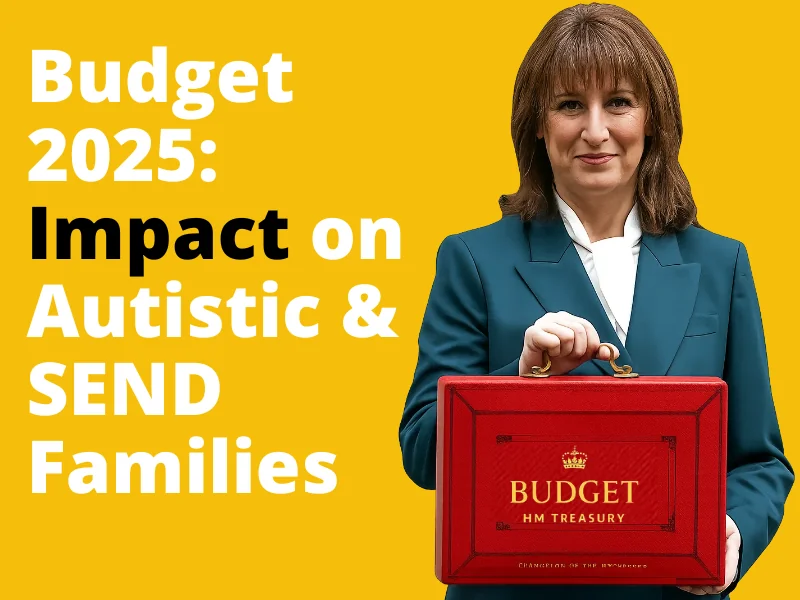
The Autumn Budget dropped – and as usual, it came with a mix of announcements, promises, quiet caveats, and “please read the small print before celebrating” moments. If you’re autistic, disabled, caring for someone who is, or navigating the SEND system… this stuff hits differently. Budgets aren’t abstract; they shape daily life – everything from energy bills to childcare to whether a PIP form lands on your doormat again. So here’s a no-nonsense, totally jargon-free breakdown of what this Budget really means for autistic people, disabled households and SEND families. Let’s get into it.
1. The Big One: The Two-Child Limit Is Being Scrapped
Let’s start with the single most significant change for families.
From April 2026, families on Universal Credit will once again receive the child element for every child — including the third, fourth or fifth, if you have a big crew.
This rule has hit SEND families especially hard for years. Why?
- Families with more than one disabled child are common.
- Poverty rates are higher in families with disabled children.
- Extra costs of disability can be brutal – therapies, transport, uniforms, sensory equipment, heating…the list goes on.
The government predicts that scrapping the two-child limit could lift up to 450,000 children out of poverty.
That’s huge.
But – brace yourself – there’s a catch.
If your Universal Credit includes “transitional protection”, your extra child payments might be shaved off that amount until the transitional element runs down.
Still, this is the most positive, meaningful shift in benefits policy in nearly a decade.

The aim is simple but meaningful: raise funds, spark curiosity, and give more people a genuine understanding of autism and the importance of neuro-affirming language. With input from I AM on key messages, resources, and on-the-ground materials, the day will offer both fun engagement and valuable insight into public awareness among students. All quiz results will be summarised and shared with the charity after the event.
It’s a collaboration built on openness, learning, and a shared commitment to better support autistic people across Greater Manchester – and we’re excited to bring it to life on campus.
2. Universal Credit Childcare Support Is Increasing
This one’s a quiet win for parents who work and rely on childcare.
Childcare for more than two children will be reimbursed at higher levels. If you’ve got three or more children in registered childcare, your maximum entitlement will rise by £736.06 per extra child per month.
For SEND families, this matters because:
Why drop in?
- Specialist childcare is rare and often more expensive.
- Parents of autistic children are more likely to work part-time or flexible jobs.
- Childcare shortages hit disabled children hardest.
It won’t solve the accessibility problem – but it may finally stop some parents from financially sinking just to stay in employment.

3. Motability Scheme: Costs Going Up… but Not for Everyone
This one caused a bit of a ripple – and understandably.
From July 2026, Motability leases will now have:
- VAT added to advance payments for more expensive vehicles
- Insurance Premium Tax added
- Some “premium” car brands removed altogether
This will make some vehicles pricier to access.
BUT – and this is an essential detail –
vehicles designed for or substantially and permanently adapted for wheelchair or stretcher users are exempt.
If you rely on Motability due to mobility needs, sensory issues, medical conditions or co-occurring disabilities, you may want to review your options well ahead of time.
4. Benefits Are Going Up (Sort Of)
From April 2026, most working-age benefits will rise with inflation at 3.8%.
Universal Credit’s standard allowance will rise 6%.
And the National Minimum Wage jumps to £12.71 an hour – which should also nudge the Carer’s Allowance earnings limit upward.
SEND carers often dance on a tightrope trying to work just enough without losing crucial support. So a higher earnings limit is welcome (even if long overdue).

5. Assessments: More Face-to-Face WCA and PIP, Fewer Pointless Reassessments
From April 2026:
- There’ll be more face-to-face PIP and Work Capability Assessments
- The DWP is expanding capacity to do more reassessments
- But… fewer PIP reassessments will be triggered for people with no change in function
This is a mixed bag.
Why autistic people may worry:
- Face-to-face assessments are often sensory minefields.
- Inconsistent assessors = inconsistent decisions.
Why autistic people may feel relieved:
- Less frequent reassessment for stable lifelong conditions is sensible and humane.
It’s the DWP, so: cautiously optimistic, but bring snacks and take deep breaths.
6. Earnings Disregard Boost for Supported and Temporary Accommodation
From Autumn 2026, people living in supported or temporary accommodation can keep more of what they earn before it affects their Housing Benefit or UC.
This is a genuinely positive step for autistic adults in supported living who want to work without losing essential stability.
7. Youth Guarantee: More Funding for Young People on UC
Young autistic jobseekers – who face some of the highest unemployment rates in the UK – may benefit from:
- Extra funding for employment support
- Skills development
- A guaranteed six-month paid work placement for 18–21-year-olds on UC for 18 months
It’s promising… but the quality and accessibility of these placements will make or break it.

8. Energy Bills: A £150 Saving from 2026
Green levies are being removed from bills in England, Scotland and Wales.
For SEND households, this matters because:
- Disabled families use more electricity
- Autistic people may need heating stability
- Medical devices, monitors and sensory equipment raise usage
A £150 reduction isn’t life-changing, but it’s not nothing.
9. Big Picture: How Does This All Add Up for Autistic and SEND Families?
In plain English:
Some things will get easier. Some things will get pricier. Some things will get more complicated.
Wins:
- Two-child limit scrapped
- Higher childcare support
- Benefit uprating
- More realistic PIP reassessment timelines
- Energy bill help
- Better earnings rules for supported housing
- Youth employment investment
Challenges:
- Motability becoming more expensive for many
- More face-to-face assessments
- Transitional protection confusion
- The usual “wait and see if it actually works” factor
For many SEND households, this Budget offers a mixture of meaningful relief and new anxieties.

10. Where I AM Comes In
At I AM Celebrating Autism, supporting autistic people across Greater Manchester is the whole mission – whether that’s:
- wellbeing groups
- advocacy
- mentoring
- social groups
- help navigating benefits or assessments
- guidance for parents and carers
If you need someone who actually gets it, the team is here:
📞 0161 866 8483
📧 enquiries@i-am-autism.org.uk
📌 If You’re Struggling – Here Are Trusted Helplines
Budget talk can get overwhelming, especially when your life is already full of forms, assessments, phone queues and uncertainty. Here are safe places for support
For more information, visit: alliancembs.manchester.ac.uk
I AM Celebrating Autism
- 0161 866 8483
- enquiries@i-am-autism.org.uk
Support for autistic adults and families in Greater Manchester.
Autism & SEND Support
- National Autistic Society Helpline – 0808 800 4104
- Contact (for families of disabled children) – https://contact.org.uk/ – 0808 808 3555
- IPSEA (SEND legal advice) – 01799 582030
- Scope Disability Helpline – 0808 800 3333
Money, Benefits & Debt
- Citizens Advice – 0800 144 8848
- National Debtline – 0808 808 4000
- StepChange – 0800 138 1111
- MoneyHelper – 0800 138 7777
Mental Health
- Samaritans – 116 123
- Shout – text SHOUT to 85258
- NHS Crisis Line – via your local trust
You don’t need to navigate any of this alone.


